Book a free consultation
What we doProcessCase studiesToolkitAboutBlog Book a free consultation
Daybook
  • Johannesburg, South Africa
  • MVP
  • Direct client

Daybook

The personal assistant that turned out to be software.

Jon Berkowitz co-founded MotionAds. Like most founders, his real job is being the person everything routes through, and no system he tried could hold it: Notion, Apple Reminders, pen and paper, a wall of sticky notes. He had hired a personal assistant before, and that did not stick either. When we started, he was pricing another one. We built Daybook instead.

~1 week
Of build effort, end to end
~5 hrs
Of rework across three weeks of client testing
1 PR
Merged to production by the client, on the handover call

The problem

The problem was never that Jon needed a task app. He had churned through most of the famous ones, and each of them worked exactly as advertised.

The problem was capture. Tasks were being created everywhere, in meetings, in email, in his own head at 11pm, but they only became visible if he manually filed them, and the manual step is exactly what a drowning founder never does. Things slipped. The stress of knowing things were slipping, without knowing which things, was the real cost.

So the brief was one sentence: nothing slips through the cracks without Jon doing the filing himself. Below is how we got there.

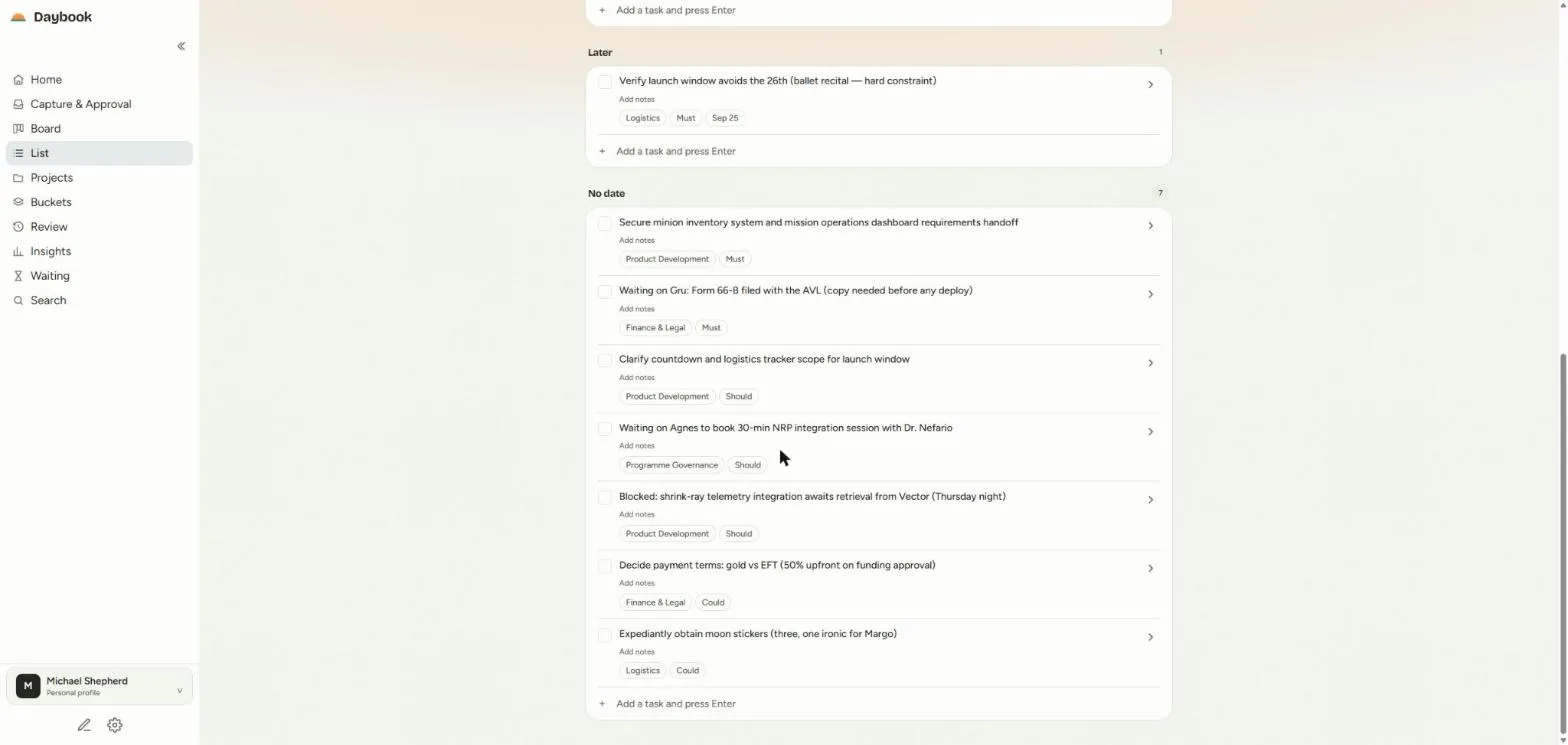
Daybook's Capture and Approval screen, showing a capture box and proposed tasks and people awaiting approval.
Anything can be thrown at the capture box. What comes back is a queue of proposals, grouped by the kind of change they make rather than by how confident the model is. Shown with demonstration data.

What we built

A command centre with one core loop.

Under the hood Daybook is not a toy. Three AI agents run inside the app, alongside Fathom, Outlook and Google integrations, and all of it exists to serve a single loop: things arrive, Claude proposes, the founder decides.

Capture

Tasks that file themselves

Meeting notes, emails and calendar activity flow into a triage board on their own. Claude reads them and proposes tasks, and Jon approves the ones worth keeping or deletes in bulk when the AI gets it wrong. The founder never does the filing, only the deciding, which is the whole point: the manual step is exactly what a drowning founder never gets to.

Result: Tasks file themselves. The founder only decides.
One board

A single place that answers the question

Approved tasks land on a Kanban board with columns, categories, parent and child dependencies, notes and links. A stripped-down list view serves anyone who just wants to know what is on their plate today, grouped by when it is due.

Result: One place answers what is open, what is waiting, and on whom.

Two worlds

Work and personal, kept apart

Separate work and personal profiles, on the same board mechanics. Buying an apartment turned out to be a project with dependencies, the same as running a company, so it gets the same treatment and stays out of the work view.

Result: A personal backlog migrated in one weekend, and off his mind.

Architecture

Claude-native by design

Daybook has no Gmail connector and it does not need one. A scheduled Claude task reads Gmail daily and files what matters into triage. The app stays small and the AI layer does the reaching, which is a deliberate architectural choice rather than a shortcut: three AI agents run inside the product, alongside Fathom, Outlook and Google integrations.

Result: New integrations cost a prompt, not a project. The client sets them up himself.

In the product

Two views, one backlog.

Approved work lands in the same place whichever way it arrived. The board is for shaping the week, and the list is for getting through a day.

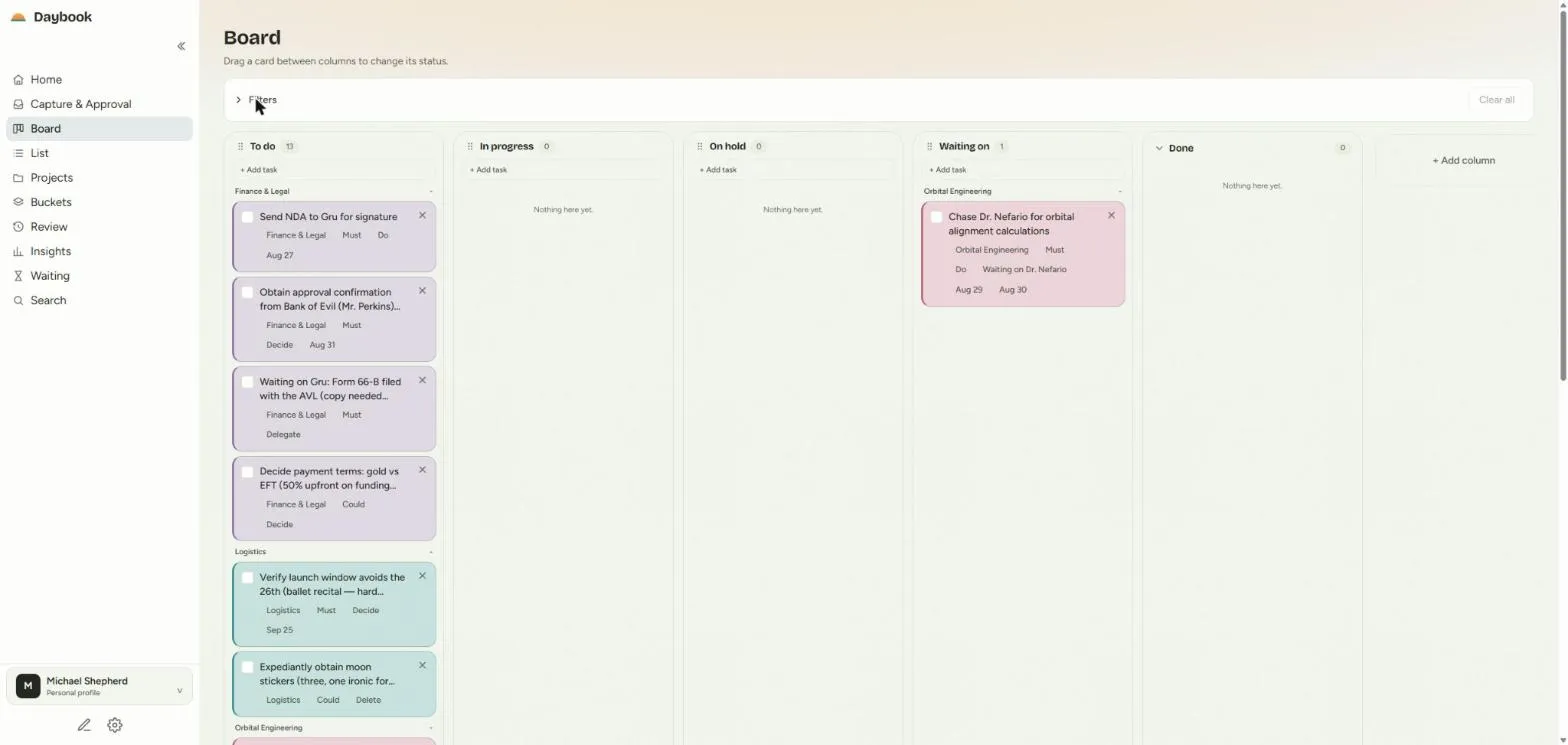
The Daybook board, with tasks grouped by category across To do, In progress, On hold, Waiting on and Done columns.
The board groups by category inside each column, and a task can wait on a named person. Shown with demonstration data.
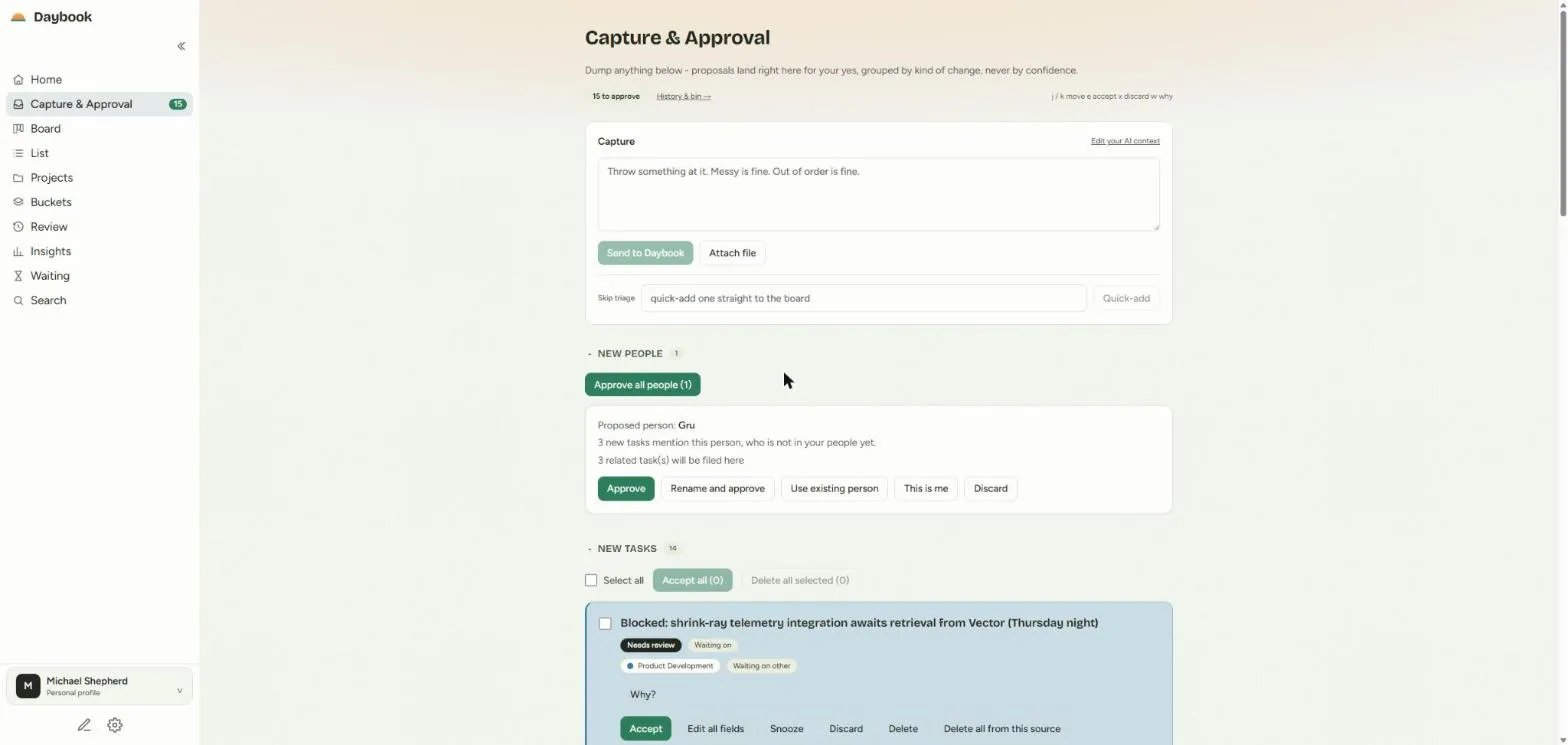
The Daybook list view, with tasks grouped by due date and tagged by category and priority.
The list view drops the columns and groups by due date instead, for the mornings that only need a running order. Shown with demonstration data.

Value delivered

A hire that never had to happen.

The deliverable was never just software. It was the end of a salary conversation, and a founder who could stop holding his whole company in his head.

A PA, not hired
The salary conversation ended. Software now does the capture, triage and follow-up a personal assistant would have
Four tools, one board
Notion, Apple Reminders, pen and paper and the sticky-note wall, retired in a weekend and still retired three weeks later
Owned and extendable
The client ships his own changes through Claude Code, behind automated tests and our review

The handover

Most handovers are a folder and a goodbye.

On the final call we connected Jon, who is not a developer, to the Daybook repository through Claude Code. He described a change in plain English, watched Claude write the code and open a pull request, watched the test suite run, and merged it to production himself. It cost a few dollars and took minutes.

The guardrails are the point. Tests must pass before anything merges. We review every pull request. And one line never moves: Claude can change the code, never the production database. He can restyle and extend freely, and his data cannot be harmed by a bad prompt.

That is what handover means here. Not receiving a product, but being able to evolve it, with a net underneath.

This is 100% what I was thinking, done better and faster, and more sustainably. Nothing else worked — and DayBook works. It literally saved my sanity.

Jon Berkowitz Co-founder, MotionAds Ask him directly

The toolkit

What it runs on.

  • Supabase Auth and PostgreSQL database
  • GitHub and CI Every change tested before it merges
  • Claude Code The client's own development environment
  • Claude agents and skills In-app triage agents and scheduled capture from Gmail
  • Integrations Fathom, Outlook and Google Calendar

Got a brain worth organising?

We start every relationship with a free consultation: an honest conversation about what you are trying to do. No pitch, no obligation.

Book a free consultation