Book a free consultation
What we doProcessCase studiesToolkitAboutBlog Book a free consultation
SkillVault
  • Johannesburg, South Africa
  • Internal product
  • Live, invitation only

SkillVault

The system of record for the skills our AI tools run on.

Our team does not work in one AI tool. We move between Claude, Cursor and others depending on the job, and each of them wanted its own copy of the skills we rely on. Copies drift. Before long nobody could say which version of a skill was current, or which tool was still running the old one. We needed one governed home for all of it, so we built SkillVault.

3 weeks
From first commit to production
16
Epics built in parallel agent waves
1
Endpoint for every AI client
1,000+
Database tests guarding permissions

The problem

The problem was never writing skills. It was keeping them the same everywhere.

A skill that improves in one tool stays stale in the other three. A fix made on one laptop never reaches the next person. Nobody could see which skills were actually being used, or whether a change had made them better or worse. For a team whose whole delivery process runs on AI, that meant the process itself had no single source of truth.

So the brief was short: write a skill once, change it deliberately, and have every tool read the same version.

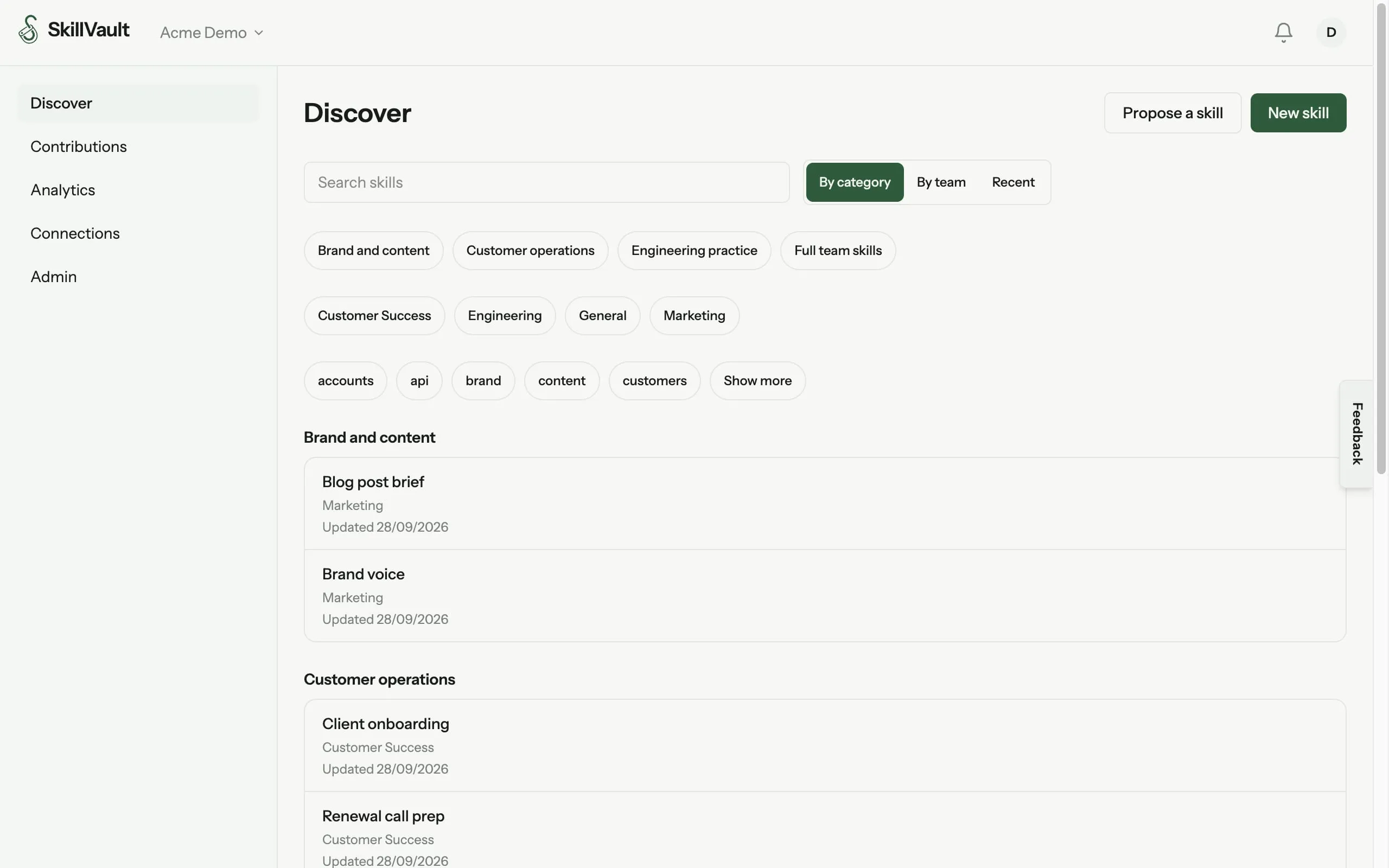
The SkillVault library, listing skills with their category, owning team and tags.
One library for the whole organisation. Each skill has one team that governs it, and categories decide which teams can read it. Shown with demonstration data.

What we built

One library, one endpoint, every client.

SkillVault is a vendor-neutral repository for AI skills. It is not a gateway and not a marketplace. Skills are plain markdown, the repository is the product, and MCP is simply how AI tools read it.

Distribution

One endpoint, every client

A single MCP endpoint serves each person every skill they can reach, across every organisation they belong to. People connect their AI client through the browser once, and there is nothing to set up per tool. Listing a skill and reading it are separate calls, so a client only loads the skills it actually uses.

Result: Claude, Cursor and our own agents all read the same live version.
Governance

Change, on the record

Only authorised admins change a skill. Every save becomes an immutable version you can compare and roll back to, and an audit trail records who did what and when. Permissions are checked live on every request, so removing someone takes effect immediately.

Result: A bad edit costs a rollback, not an investigation.

Collaboration

Everyone contributes, admins decide

Anyone can raise feedback, report an issue or propose an improvement, including from inside their AI client while they are using the skill. Admins review the proposed change side by side with the current version and choose what lands.

Result: Improvements come from the people using the skills, without anyone losing control of them.

Visibility

Know what is actually used

Usage is recorded when a skill is read, not when a client connects, so the analytics mean something. They show which skills are retrieved most, which teams and clients use them, and how often a use ends in success.

Result: We retire what nobody reads and invest in what everyone does.

In the product

Built for the people who write skills, and the people who use them.

Admins get versioning, review and analytics. Everyone else gets their skills inside the AI tool they already use, and a way to say when one could be better.

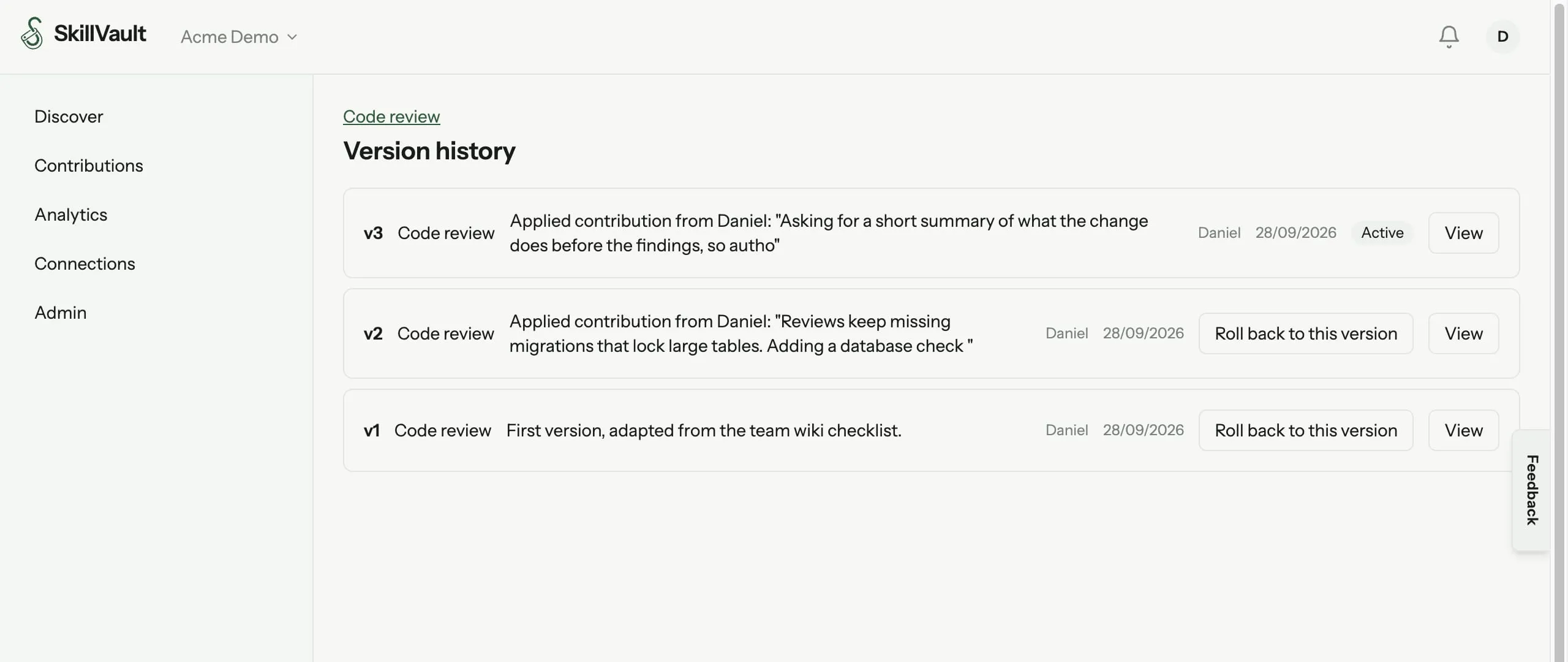
A SkillVault skill page showing its version history, with each saved version listed by author and date.
Every save writes a new version, with who made it and why. Any earlier one can be restored in one step. Shown with demonstration data.
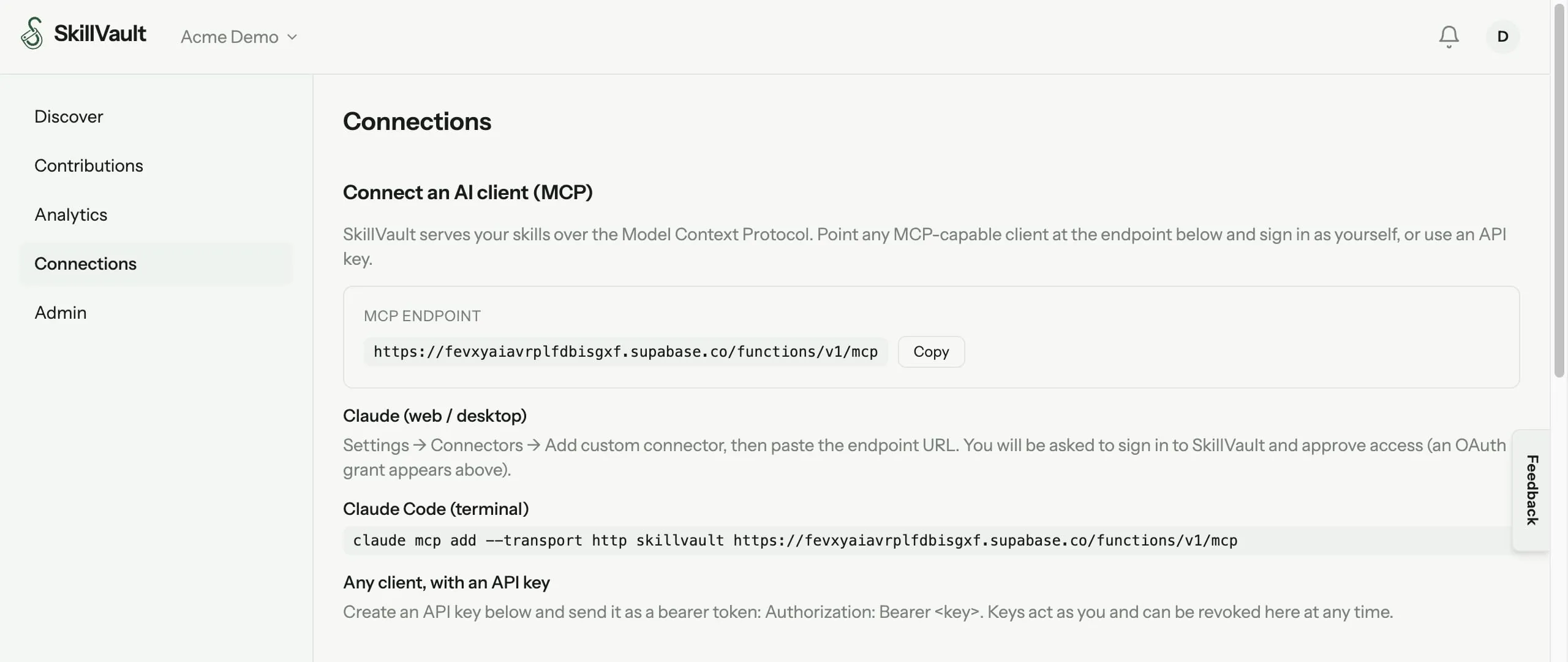
The SkillVault Connections screen, with the single MCP endpoint and setup steps for Claude, Claude Code and API keys.
Connecting a client is one endpoint and one browser sign-in, whichever tool you use. Shown with demonstration data.
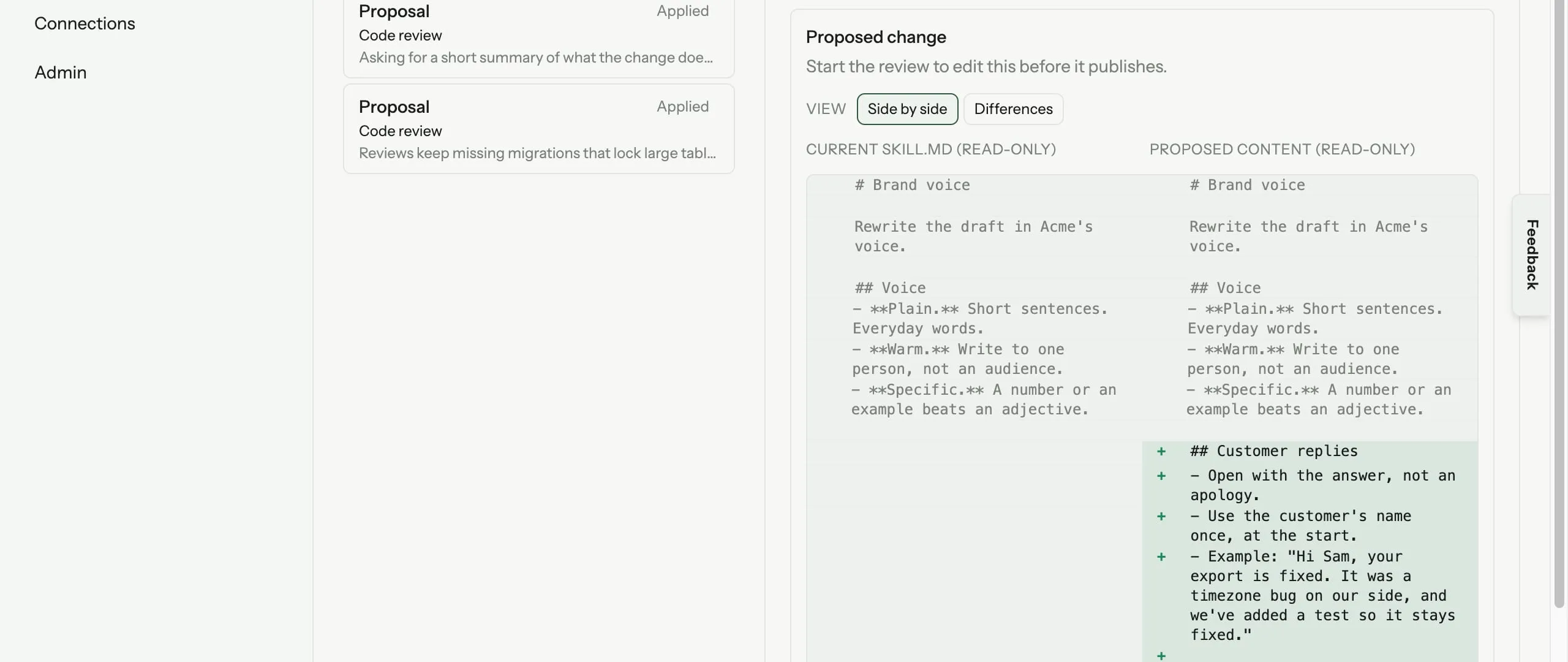
A SkillVault improvement proposal, showing the current skill and the proposed change side by side with the added lines highlighted.
Members propose changes, admins review them against the current version and decide what lands. Shown with demonstration data.
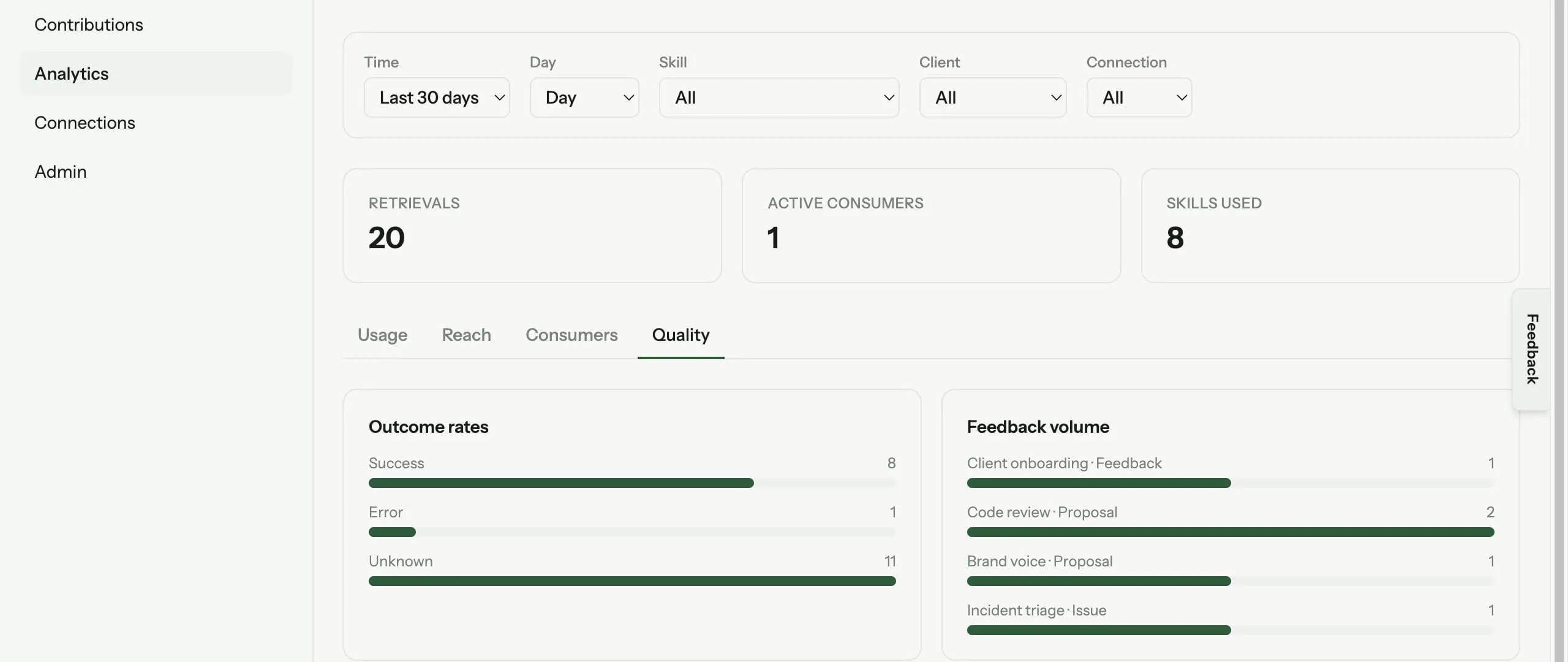
SkillVault analytics showing retrievals, active consumers and skills used, with outcome rates and feedback volume by skill.
Retrievals, reach and outcomes by skill, team and client, including how often a use ends in success. Shown with demonstration data.

How we built it

Three weeks, and the process was the point.

SkillVault was built with our own AI-orchestrated delivery process. We wrote the product spec first and had it reviewed independently, then split the build into sixteen epics and ran them in dependency waves: several agents building at once, each on its own branch against its own isolated database, with a lead merging and verifying every wave before the next one started.

The guardrails did the heavy lifting. Permission rules live in the database and are covered by more than a thousand automated tests, and nothing merges unless the suite passes. Speed came from parallel work. Confidence came from never letting any of it merge unchecked.

It is the same process we run on client projects. SkillVault is where we proved it on ourselves first, and today it stores the skills that process runs on.

Value delivered

Our own process, running on one source of truth.

The team stopped maintaining skills tool by tool. Now there is one place to improve a skill, and every tool picks up the improvement.

Written once
Every skill lives in one library instead of a copy per tool, per person
Read everywhere
Every AI client the team uses reads the same current version
Changed deliberately
Every edit is versioned, attributed and reversible
Proven in‑house
Our own delivery process runs on it before any client project does

The toolkit

What it runs on.

  • Angular and spartan/ui The web application
  • Supabase Auth, OAuth 2.1 and PostgreSQL with row-level security
  • Supabase Edge Functions The MCP endpoint and REST API
  • Cloudflare Hosting and delivery
  • GitHub and CI Every change tested before it merges
  • Claude Code and parallel agents The build process itself

Got skills scattered across your AI tools?

We start every relationship with a free consultation: an honest conversation about what you are trying to do. No pitch, no obligation.