

The AI "Disruptive Genius"
AI agents are geniuses with no memory. How spec-driven, test-first guardrails stop your coding agent from wrecking your codebase.
 Michael Shepherd 6 min read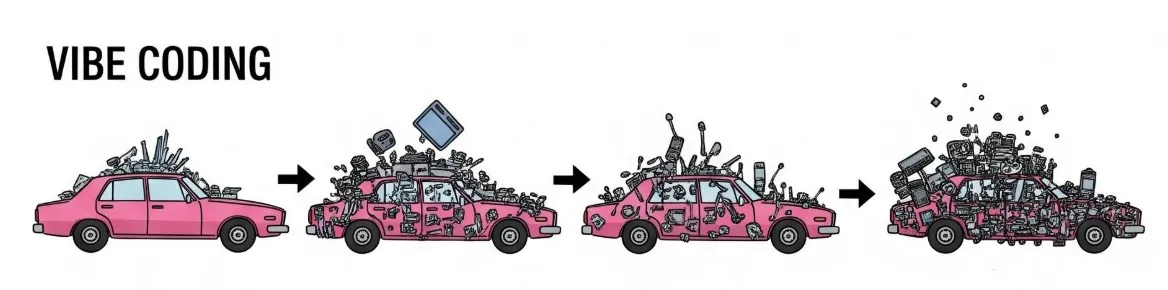
TL;DR:
AI agents are brilliant but lack “institutional memory,” often prioritising immediate tasks over long-term system stability.
To prevent your codebase from becoming a fragmented mess, shift your role from coder to validator using a Spec-Driven/Test-First workflow.
By enforcing strict guardrails, like forcing AI to write tests before code and using the tools available to you, you can harness AI’s speed without inheriting its technical debt.
We’ve all worked with that one developer. They are incredibly fast and talented, but they’re also convinced that everything in the existing codebase needs to be rewritten their way. Usually, they end up making things more complicated for everyone else.
In 2026, that developer is an AI agent.
The problem isn’t that tools like Claude Code or OpenAI’s Codex are “bad” at coding. The problem is that they are geniuses with no memory. Every time you start a new task, you are essentially hiring a brand-new lead architect who has no idea why your system was built the way it was.
The Problem: Innovation Without Consistency
When you use an AI agent in a large team, it prioritises solving the immediate task over keeping the whole system stable. Without strict rules, AI agents tend to:
- Make Up New Rules: They might introduce a new way of handling data or styling a page just because it seems “better” for that specific moment.
- Ignore History: They don’t know about the hidden bugs or specific reasons why your team chose one path over another years ago.
- Create “Blind” Developers: When people use AI to write code they don’t fully understand, they become a “force multiplier” for chaos. They ship code that works today but breaks the standards that keep the project manageable tomorrow.
The result? A codebase that looks like it was written by ten different people who never talked to each other.
The Solution: Setting Up Guardrails
To stop this “disruptive genius” from creating a mess, you have to change how you work. You need to focus on three things: building the right thing, building it the right way, and testing, testing, testing.
1. Building the Right Thing (Spec-Driven Development)
Don’t just ask the AI to “write a feature.” Use the AI to help you write a clear Specification first. Use it to find holes in your logic and define exactly what needs to happen. If the plan is bad, the AI will just help you fail faster.
2. Building it the Right Way (The Rules)
Once the plan is ready, you need to set boundaries that the AI cannot cross:
- Automated Standards: Use tools that automatically check for your team’s specific patterns. If the AI tries to use a “new” way of doing things that doesn’t match your standards, the system should reject it immediately.
- Tests are the Fence: Make the AI write the tests first. Once a human developer confirms the tests are correct, only then should the AI write the actual code. This keeps the AI focused on the goal.
- Humans Make the Decisions: Never let an AI make an architectural assumption. If the AI is confused or sees two ways to do something, it must be forced to stop and ask a human developer for the answer.
3. The “Test Like Your Life Depends On It” Rule
The biggest change is for the developers. Your job is no longer just writing code; it’s validating it.
- More Layers: You need unit tests, integration tests, and smoke tests for everything the AI touches.
- The Responsibility: Developers must test the code personally and thoroughly before it ever moves to the next stage. If you didn’t verify it, you shouldn’t ship it.
Putting it into Practice: The Anti-Chaos Workflow
To give you an idea of what this looks like in the real world, here is how a developer can use Claude Code along with the skills from the Anthropic Skills repository (and the broader ecosystem) to manage the “disruptive genius” during a standard feature request.
Phase 1: Building the Right Thing (Spec-Driven Development)
The goal here is to stop the AI from making assumptions about the business logic.
- The Skill:
/grill-me - The Workflow: Before writing code, the developer invokes
/grill-me. The AI acts as a rigorous interviewer, asking pointed questions about edge cases, security, and architectural fit. - The Result: You uncover that “hidden plumbing” issue before the AI starts refactoring the database.
Phase 2: Defining the Plan
Once the requirements are clear, you need to turn them into actionable, standardised tasks.
- The Skill:
/prd-to-issues - The Workflow: Claude takes the refined spec and breaks it down into small, trackable technical tasks that align with your team’s existing issue templates.
- The Result: Every AI contribution is now mapped to a human-approved plan.
Phase 3: Building it Right (The TDD Fence)
This is where you prevent the agent from “replumbing” the system under the guise of progress.
- The Skill:
/tdd - The Workflow: The developer uses the
/tddskill to force a “Tests First” approach. The AI writes the unit tests based on the spec; the human developer reviews and approves them. Only then is the AI permitted to write the implementation. - The Result: The AI is physically constrained by the tests. If it tries to rewrite a global module that isn’t in the spec, the tests will fail.
Phase 4: Enforcing UI Consistency
To keep the frontend from looking like a patchwork of different “good ideas,” you use a design gate.
- The Skill:
/frontend-design - The Workflow: By feeding your team’s design system into this skill, you ensure Claude uses your specific components (like
@enterprise/ui-kit) rather than inventing custom CSS that will be impossible to maintain.
Phase 5: The Final Quality Gate
Before the code ever reaches a human reviewer, it must pass an automated architectural audit.
- The Skill:
/code-reviewer - The Workflow: The developer runs
/code-reviewerwith a custom instruction: “Check for any violations of our Layered Architecture patterns.” - The Result: The AI catches its own mistakes—like trying to call the database directly from the UI—and corrects them before a human even has to look at the PR.
Takeaways
In an era where it’s tempting to let machines do the thinking, rigorous process and team alignment are what separate professional engineering from amateur shortcuts. The workflow I’ve described is just one way to blend human intuition with raw AI power, but the principle remains the same: “vibe coding” doesn’t have to result in technical debt. To truly master these new tools and build scalable systems, developers must lean into their new reality, thinking harder and more strategically than ever, even as they spend less time manually writing code.
At One Eleven, we build software the same way we think about it: code is the medium, value is the point. We work to make sure clients never walk out of a review wondering what it was all for.
Start a conversationMichael Shepherd
COO / CTO
Lives between the business problem and the build, keeping operations tight and the technology pointed at outcomes.